A geometrical approach to global pandemics
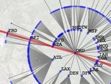
Using the notion of effective
distance in a globally connected world we take a
geometric approach to the dynamic phenomena such as
the global spread of emergent infectious diseases.
Using this method, complex spreading phenomena are
mapped onto simple, familiar concentric waves.
more...
SPaTo - Visual Explorer
In this project, we develop a new
visualization method in which the node positions are
precisely based on network properties. Typically,
networks are reduced to their minimum spanning tree to
obtain a planar subgraph, but here we propose to use
the shortest-path tree of some specified node instead.
This way we do not only obtain a graph that is
embeddable in 2-D space but also provides a canonical
distance between each node and the (selected) root
node that can be used to determine node positions in
the layout, namely the shortest-path distance. more...
A local perspective of network resilience to real-world
disasters
In April 2010, a volcanic ash cloud obstructed large
parts of the European air space and caused many airport
closures and flight cancellations. Although this “defect”
in the aviation system was regionally confined, it caused
percussions around the globe. Taking a local perspective,
we are developing new methods to quantify the impact of
real-world attacks and failures in complex networks.
 more...
Dynamics of Vaccination with Imperfect Knowledge
A high enough vaccine coverage level can eradicate a
disease from a population. However, if individuals believe
there is any risk associated with the vaccine, vaccination
decisions driven by rational self-interest can keep the
overall vaccination below this level. Interestingly,
limiting the amount of information about the disease
dynamics that individuals possess can make eradication of
the disease more likely.
 more...
Tour de Sys: The Traveler's View of a Network
Tomography is a procedure long used in the biological
and physical sciences to study an object by producing
images of many thin slices of it, rather than trying to
study a picture of the entire object all at one. In this
project, we apply this idea to complex networks. Using
shortest-path trees to organize the network into a series
of slices allows us to measure global properties of the
system conditioned on location.
 more...
Community Structure in Multi-Scale Transportation
Networks
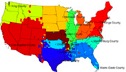
Large scale communities and their geographical
boundaries are key determinants of various human mediated
spatially extended dynamical phenomena. The geographic
spread of emergent human infectious diseases such as SARS
(severe acute respiratory system) and seasonal and pandemic
influenza A are prime examples.
 more...
Travel Bugs, Geocaching and European Traffic
Networks
In this project we investigate the behavior of over
900,000 travel bugs. These tagged items play a role in a
popular international game known as geocaching (see e.g.
www.geocaching.com), a modern type of
GPS treasure hunt. Travel bugs travel long distances
across political, national and regional boundaries and
their position is known with very high precision.
 more...
Impact of Social Heterogeneities in Epidemic
Outbreaks
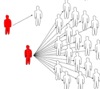
Typical epidemiological models rest on two key
assumptions: That a population is well mixed and that
transmission is triggered by a population-averaged contact
rate. However, experimental evidence shows that contact
rates vary substantially, and it has been shown that this
variability can change the dynamics of a disease.
 more...
Panic Reactions and Global Disease Dynamics
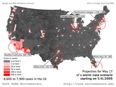
When a disease is spreading through a population, a
single person can certainly safe herself from getting
infected by running away from affected areas. However, when
a large part of the population is responding to a
forthcoming disease by changing their dispersal behavior,
the disease spread can be severely impacted, leading to
qualitatively different dynamics.
 more...



 more...
 more...
 more...